


India’s deep-tech ecosystem is steadily evolving beyond SaaS and fintech into hardware-intensive, high-precision engineering domains. Among the startups emerging from this new wave is Quintrans, a company building patented linear motor technology designed to redefine motion systems across automation, robotics, logistics, and future mobility.
Born out of an ambitious Hyperloop research initiative at MIT Pune, Quintrans is attempting something rare in the Indian startup landscape — building core electromagnetic motion IP from the ground up.
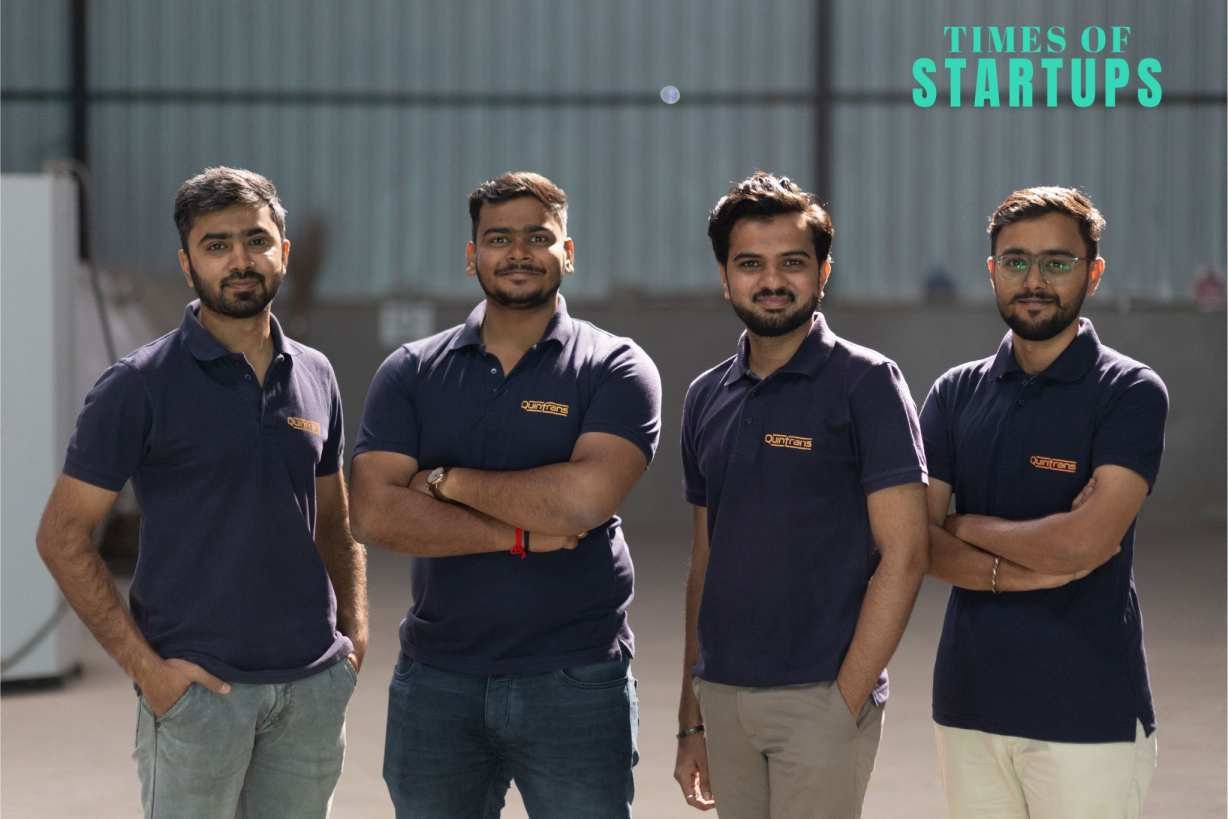
Quintrans was Co-founded by Pranay Luniya, Kartik Kulkarni, Aniruddha Atigre and Prasanna Kadambi.
In this exclusive conversation with Raunak Pathak, Prasanna Kadambi of Quintrans shares the company’s origin story, technological differentiation, manufacturing ambitions, and long-term propulsion vision.
Origin Story & Inspiration
“I was born and brought up in quite an orthodox family where businesses looked good only on shows like Shark Tank. However, as I entered my graduation years, I happened to stumble upon a group of like-minded people who were motivated to step outside lecture halls and build something out of nothing.
That led to the inception of a very focused research group called ‘Vegapod Hyperloop’ at MIT Pune, where I completed my graduation. The idea was to develop futuristic transportation technologies like linear motors and maglev systems at scale.
Through this, we were able to gauge the impact of such technologies on challenges faced across the entire spectrum of motion — from industry and transportation to potentially even interstellar needs in the future.”
Technology & Core Innovation
“Linear motors are the core patented technology at Quintrans. Similar to a rotary motor, a linear motor provides precise and high-speed contactless motion — but in a linear direction instead of rotational movement.
Like rotary motors, linear motors can be scaled across sizes and specifications to meet end applications where precision is critical.
These motors can be directly utilized as actuators to meet industrial motion requirements. Due to contactless motion, they are energy efficient, produce lower noise, and require less maintenance because of fewer mechanical components.
They provide excellent position control at high speeds — something uncharacteristic of conventional solutions like pneumatic actuators, which are typically deployed across machine automation, robotics, and manufacturing.”
Founders’ Background & Team Dynamics
“All of us met as founding members at Vegapod Hyperloop during our graduation phase. That fortunately allowed us to assess each other’s strengths and weaknesses early on.
Spending that journey together naturally led us to assume roles and responsibilities aligned with our strengths. While we come from different technical backgrounds, this diversity allows varied perspectives on technology assessment, market needs, and product development.
One of the most important aspects for founders is having complementary skill sets to balance biases. This distribution allows us to predict, supervise, and take strategic decisions as we plan the organization’s future.”
Early Challenges & Validation
“Every hardware-software integrated product goes through a tough validation and iteration cycle to achieve product-market fit.
We have been able to navigate these challenges methodically, thanks to experienced advisors and consultants. We follow the philosophy of shipping pre-product-market-fit units in focused pilot trials, allowing us to build the product alongside customer specifications.
We work closely with early customers to identify gaps in existing solutions and adapt our products accordingly. This allows controlled failure environments where data can be recorded and analyzed before commercial rollout.
While this strategy may not be widely applicable to every deep-tech startup, it supports our narrative of building momentum and establishing reliability simultaneously.”
Funding & Growth Strategy
“The funding moment was almost perfectly aligned for Quintrans. As we move toward commercializing our first set of products emerging from pilot trials, the funds will be deployed toward manufacturing these units at commercial volumes.
We are setting up operations for critical and precision machining while expanding our team to boost R&D capabilities in advanced manufacturing systems.
This supports India’s vision of achieving self-reliance in precision products through homegrown innovation. A portion of the capital will also be used to target distribution across MENA and Europe.”
Manufacturing & “Make in India” Vision
“Anchoring design and manufacturing locally allows Quintrans to iterate faster by tightly integrating engineering, production, and field feedback.
This enables rapid customization for Indian voltage conditions, temperature ranges, dust environments, and demanding duty cycles. Proximity to suppliers reduces lead times and supports application-specific adaptation.
System-level integration of motor, drive, controls, and mechanics unlocks cost competitiveness beyond labor arbitrage.
However, challenges remain in achieving high-precision supply chain repeatability, particularly in magnets, laminations, bearings, and tight tolerances. Dependence on imported specialty components like high-grade magnets and semiconductors may continue in the near term.
Building global-grade quality systems, traceability, and rigorous validation testing requires sustained investment. Overcoming customer perception bias toward established global OEMs demands strong performance data and reliability at scale.”
Industry & Market Adoption
“The market is steadily shifting from pneumatic and hydraulic systems toward electromechanical and direct-drive solutions.
Factories demand tighter repeatability, lower lifetime cost, and easier Industry 4.0 connectivity. Linear motion systems are projected to grow at a CAGR of roughly 5–6% through the late 2020s and early 2030s.
Robotics demand is expanding from large OEMs to mid-market manufacturers, increasing the installed base consuming actuators and drives.
Warehouse automation is accelerating rapidly, with logistics driving actuator demand across conveyors, sorters, palletizers, and goods-to-person systems. Infrastructure is also becoming more actuator-heavy as electrification and automation increase.”
Hyperloop & Future Mobility
“For Quintrans, balancing high-speed transportation ambitions with near-term business is about sequencing, not compromise.
Our Hyperloop roots gave us expertise in electromagnetics, controls, and integration. However, large infrastructure projects take time, capital, and policy alignment.
Instead of waiting, we apply the same core technology to industrial automation and logistics — sectors with faster adoption cycles and predictable revenue.
Every actuator we ship strengthens our manufacturing, firmware, and reliability stack. These learnings feed into our long-term propulsion vision.
We are building one scalable electromagnetic platform and monetizing it in stages.”
Ecosystem & Partnerships
“Partnerships have been foundational — not just as sources of capital but as multipliers of credibility and speed.
We have worked with incubators like FITT-IIT Delhi, AI4ICPS-IIT KGP, and NTCPWC at IIT Madras. These partnerships provided validation environments, advanced modeling access, and talent.
The key lesson for deep-tech founders is choosing partners for long-term alignment. Look for those who understand hardware timelines. Protect your core IP. Structure collaborations with defined outcomes.”
Advice for Startup Founders
“Physics doesn’t negotiate — timelines are governed by testing and failure analysis, not optimism.
Prototypes are not products. Reliability, manufacturability, and serviceability define success.
Design platforms, not just products. Validation data is your strongest currency.
Monetize adjacent opportunities while nurturing your bigger vision.
Most importantly, cultivate resilience — deep tech rewards those who persist through ambiguity while maintaining engineering rigor.”
Editorial Insights & Comparative Analysis
Quintrans enters a market traditionally dominated by global motion-control giants such as Siemens, Bosch Rexroth, Parker Hannifin, and Rockwell Automation. These incumbents have decades of reliability data and global supply chains.
What differentiates Quintrans is:
- Core Electromagnetic IP Built in India
- Hyperloop-Origin Engineering Depth
- Vertical Integration Strategy (Motor + Drive + Controls)
- Stage-wise Monetization Model
Compared to Indian automation startups that primarily integrate imported components, Quintrans is attempting indigenous core motion technology development — a significantly harder path.
Globally, companies like H2 Clipper and Hyperloop Transportation Technologies are pursuing high-speed propulsion visions, but few startups combine long-term mobility ambitions with immediate industrial revenue streams in a structured sequencing model.
The strategic sequencing approach — monetizing industrial actuators while building propulsion credibility — reduces capital risk while compounding technological depth.
If execution remains disciplined, Quintrans could position itself not merely as a component manufacturer but as a foundational motion platform company.
Final Takeaway
Quintrans represents a new archetype in India’s deep-tech landscape — founders who began with moonshot ambitions but chose disciplined commercialization pathways.
The journey from Hyperloop research lab to industrial actuator deployment reflects a broader shift in India’s innovation story: from services-first to core engineering IP.
The coming years will test their manufacturing rigor, supply chain control, and international expansion strategy. But one thing is clear — Quintrans is not just building actuators.
They are building motion infrastructure for the next industrial era.