


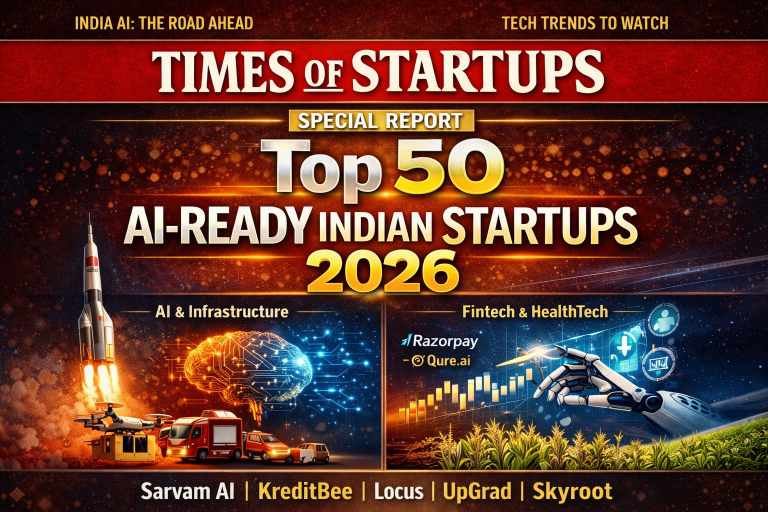
The Companies Building India’s AI-First Future
Artificial Intelligence is no longer an add-on feature. In 2026, it is the operating system of high-growth startups.
From logistics to fintech, healthcare to SaaS, Indian startups are embedding AI into core workflows — not just customer-facing features.
At Times of Startups, we analyzed companies based on:
- Depth of AI integration
- AI-native product architecture
- Automation maturity
- Market impact
- Scalability
- Innovation in applied AI
Here is our editorial list of the Top 50 AI-Ready Indian Startups 2026.
AI-Native & Infrastructure Startups
Sarvam AI
Sarvam AI builds foundational large language models and multimodal AI systems tailored for Indian languages and enterprise use. Its models power multilingual chat, voice recognition, and automated reasoning, and the company is part of India’s sovereign AI initiative under IndiaAI Mission. By focusing on regional linguistic support and scalable agents, Sarvam is positioned as a key domestic competitor to global AI giants.
Krutrim
Krutrim develops India’s own large language models and AI infrastructure, including multilingual models optimized for Indic languages and user scenarios. Its AI agents such as Kruti execute real-world tasks — like booking services — and represent a push toward indigenous AI autonomy. Though facing global competition, Krutrim’s stack aims to compete across language, experience, and accessibility layers.
Haptik
Haptik is a conversational AI startup that enables enterprises to build intelligent chatbot and voice interfaces. Acquired by Jio Platforms, its technology allows natural language understanding and automated interaction across customer support channels. By reducing manual support costs and increasing engagement, Haptik demonstrates how AI can scale human communication.
Uniphore
Uniphore uses voice-centric AI to automate and enhance customer interactions for enterprises, combining speech analytics with machine learning to decode accents, emotions, and intent. Its platform integrates speech, video, text, and data to augment human agents and help automate complex workflows. This strong emphasis on multimodal AI makes Uniphore a standout in customer experience AI.
Yellow.ai
Yellow.ai delivers enterprise-grade conversational AI across chat and voice at global scale, supporting over 135 languages on multiple channels. Its platform uses machine learning and generative AI to automate customer support, commerce, and employee experience interactions. By training on billions of conversations, Yellow.ai continuously improves automation accuracy.
AI in Fintech
Razorpay
Razorpay provides payment infrastructure and financial services to Indian businesses, including payment gateways, working capital solutions, and automated payouts. While not exclusively an AI company, Razorpay integrates machine learning to optimize fraud detection, payment routing, and customer insights. Newer AI-driven features extend conversational payment interactions and predictive analytics.
ZestMoney
ZestMoney uses data-driven underwriting models to offer digital credit to consumers without traditional credit histories. Machine learning algorithms assess risk and repayment likelihood, enabling wider access to affordable credit. Its AI-enabled decisioning helps improve approval accuracy and consumer financial experience.
KreditBee
KreditBee leverages predictive analytics and AI models to automate credit scoring, fraud detection, and loan offer personalization. By analyzing digital footprints and transaction behavior, the platform can rapidly determine creditworthiness. This AI edge helps expand lending to under-served segments.
Perfios
Perfios uses AI to extract, interpret, and score financial data across documents and systems, making complex data usable for lenders and financial institutions. Its machine learning pipelines automate pattern recognition in unstructured documents. This ability accelerates onboarding and risk assessment in fintech workflows.
Signzy
Signzy combines AI with blockchain and computer vision to automate compliance, KYC (Know Your Customer), and risk checks for digital finance companies. Its AI models validate identities and documents without manual review. This dramatically shortens onboarding cycles while maintaining regulatory rigor.
AI in Healthcare
Qure.ai
Qure.ai applies deep learning to medical imaging to help detect diseases such as tuberculosis, strokes, and lung nodules with speed and accuracy. Its algorithms can prioritize critical cases and accelerate diagnostic workflows in hospitals. This AI-driven efficiency can reduce errors and improve patient outcomes.
HealthifyMe
HealthifyMe combines AI coaches with human nutritionists to provide personalized diet plans, fitness tracking, and lifestyle optimization. Its machine learning models adapt plans based on user behavior and metabolism. By blending AI and human guidance, it scales health support to millions.
SigTuple
SigTuple leverages AI to automate laboratory diagnostics by analyzing digital microscope images for anomalies. Its algorithms help detect infections and blood disorders faster than manual review. This reduces turnaround times and standardizes results across clinics.
Niramai
Niramai uses thermal imaging and machine learning to detect early signs of breast cancer in a non-invasive way. Its AI analyzes thermal patterns invisible to the human eye, offering an affordable alternative to traditional screening. This can improve early detection, especially in resource-limited settings.
Tricog
Tricog integrates AI into cardiac care by automating ECG analysis and delivering rapid interpretations to clinicians. Its system can flag life-threatening abnormalities in minutes, aiding emergency decisions. This speed and consistency elevate care in critical situations.
AI in Logistics & Supply Chain
Locus
Locus uses machine learning and optimization algorithms to automate route planning, resource allocation, and delivery logistics. Its platform reduces transit times and costs while improving reliability for supply chains. Predictive analytics helps fleets adapt to real-time conditions.
FarEye
FarEye’s AI engine predicts delivery timelines, optimizes dispatch decisions, and enhances customer tracking experiences. The platform’s machine learning models reduce delays by learning from historical and real-time data. This boosts delivery efficiency for large logistics networks.
BlackBuck
BlackBuck connects truck drivers with shippers using data science to match demand and supply across routes. Its AI evaluates pricing, availability, and route efficiency to recommend optimal pairings. This reduces idle time and improves freight cost efficiency.
ElasticRun
ElasticRun combines predictive analytics with marketplace dynamics to streamline retail and distribution networks. Its AI identifies demand patterns and allocates inventory accordingly. This reduces stockouts and operational friction.
Loadshare
Loadshare uses machine learning to coordinate hub-to-hub freight movement, reducing deadhead miles and delivery delays. Its algorithms forecast demand spikes, enabling scalable dispatch planning. This improves operational margins for logistics partners.
AI in E-Commerce & Retail
Meesho
Meesho uses AI-driven recommendations and seller analytics to personalize shopping experiences for millions of users across India. Its machine learning models optimize product visibility and conversion on social channels. By automating inventory insights and demand forecasting, Meesho scales commerce for small merchants.
Flipkart
Flipkart leverages advanced AI across search ranking, fraud detection, logistics routing, and personalized feeds to drive high-volume transactions. Its deep learning systems help tailor recommendations to individual users at scale. These capabilities significantly improve user retention and conversion rates.
Moglix
Moglix applies AI to supply chain and procurement operations for industrial buyers, automating product discovery and demand prediction. Its intelligent systems help reduce procurement cycles and optimize inventory levels. By using predictive analytics, Moglix supports data-driven decision making in B2B commerce.
DealShare
DealShare integrates AI into social commerce by analyzing group buying behaviors and optimizing product recommendations. Its machine learning models predict trending products and price elasticity for regional markets. This allows DealShare to improve engagement and transaction frequency.
Fynd
Fynd uses machine learning to bridge offline and online retail through intelligent inventory management and demand forecasting. Its AI-powered systems help brands optimize supply chains and reduce stock obsolescence. Fynd’s predictive analytics layer enhances customer satisfaction with faster deliveries and accurate recommendations.
AI in SaaS & Enterprise Tech
Zoho
Zoho embeds AI across its productivity and CRM suite through its proprietary AI assistant, Zia, which predicts trends, automates tasks, and generates insights. Its platforms provide automated anomaly detection in sales and support workflows. By integrating AI into every application layer, Zoho helps businesses operate more efficiently.
Freshworks
Freshworks uses AI to automate customer support, lead scoring, and sentiment analysis with its Freddy AI platform. Freddy helps detect patterns in customer behavior and automates repetitive tasks for support teams. These capabilities empower businesses to scale service without commensurate headcount increases.
Postman
Postman applies machine learning models to improve API discoverability, testing automation, and vulnerability detection. Its AI-assisted tooling helps developers spot errors, suggest test patterns, and automate API lifecycles. This drives faster and more reliable software delivery.
BrowserStack
BrowserStack uses predictive analytics to prioritize test cases and optimize cross-browser testing workflows. Its AI layer analyzes historical testing outcomes to recommend the most impactful test runs. By automating test selection, BrowserStack saves engineering time and improves release quality.
Chargebee
Chargebee leverages AI to automate subscription billing, churn prediction, and revenue analytics. Its models help finance teams forecast revenue and identify risk patterns in customer behavior. The predictive layer also recommends pricing strategies based on historical trends.
AI in EdTech
PhysicsWallah
PhysicsWallah uses adaptive learning systems to tailor educational content based on student performance patterns. Its analytics dashboard highlights weak areas and suggests personalized revision paths. Through AI-enhanced recommendations, it boosts learning outcomes at scale.
UpGrad
UpGrad incorporates machine learning into program recommendations, learner progress tracking, and career guidance. Its AI analytics help match learners to courses and companies based on skills and goals. This improves engagement and job placement outcomes.
Vedantu
Vedantu uses AI to support personalized tutoring, adaptive lesson planning, and real-time feedback during online sessions. Its algorithms analyze student interaction and performance to tailor future instruction. This results in more effective and scalable learning experiences.
Eruditus
Eruditus employs predictive analytics to match learners with programs that drive career growth, using machine learning to analyze professional profiles and learning outcomes. Its AI-enhanced course insights help education partners optimize offerings. This data-driven approach improves learner engagement.
Embibe
Embibe’s AI learning platform uses deep analytics to identify conceptual weaknesses and recommend targeted practice. Its systems continually adapt difficulty and content sequencing based on student mastery. This supports highly personalized preparation for competitive exams.
AI in AgriTech & Climate
CropIn
CropIn uses satellite imagery and machine learning to deliver real-time farm insights, crop health monitoring, and yield predictions. Its AI models help agribusinesses make data-backed decisions that increase productivity. By automating risk detection, CropIn empowers smarter agronomic planning.
Ninjacart
Ninjacart applies AI to streamline fresh produce distribution with predictive demand modeling and route optimization. Its machine learning algorithms anticipate demand shifts and reduce wastage. This improves margin outcomes for farmers and retailers.
DeHaat
DeHaat’s AI-driven advisory platform provides soil health recommendations and crop planning suggestions using regional data patterns. Its machine learning models help farmers maximize yield and input efficiency. These insights strengthen farm decision making and profitability.
Stellapps
Stellapps uses AI and IoT sensors to monitor livestock health, milk quality, and supply chain efficiency. Its machine learning systems detect anomalies, forecast production trends, and automate quality checks. This improves operational outcomes across dairy value chains.
AgNext
AgNext combines computer vision and AI to assess agricultural quality at scale, analyzing parameters like grain attributes and produce freshness. Its AI pipelines automate inspection and grading, reducing human subjectivity. This increases efficiency and reliability in agri-commodity markets.
AI-Enabled Emerging Innovators
Pixxel
Pixxel operates a constellation of hyperspectral Earth imaging satellites, using AI to process large volumes of spatial data. Its machine learning models extract actionable insights for agriculture, environment, and climate monitoring. This positions Pixxel as a data-driven analytics provider at planetary scale.
Skyroot Aerospace
Skyroot Aerospace uses AI for flight simulation, mission planning, and propulsion optimization in its space launch systems. Its models help reduce design cycles and enhance reliability through predictive performance analysis. This AI-augmented engineering approach accelerates rocket development.
Rapido
Rapido integrates machine learning to match riders with drivers, optimize routing, and dynamically price services. Its AI models analyze traffic, demand patterns, and user preferences in real time. This enhances efficiency and reliability in micromobility operations.
Cars24
Cars24 uses predictive analytics to value used cars accurately, automates listing recommendations, and optimizes pricing with data-driven AI systems. Its algorithms analyze market trends and vehicle history to improve sale conversion. This enables faster transactions and customer trust.
Urban Company
Urban Company applies machine learning to match service professionals with customers based on preferences, ratings, and location data. Its predictive systems help streamline scheduling and pricing. This improves marketplace efficiency and user experience.
OfBusiness
OfBusiness uses AI to automate credit scoring, procurement insights, and supplier discovery for SMEs. Its machine learning suites analyze business health signals and recommend financing paths. This reduces manual underwriting friction for B2B commerce.
Udaan
Udaan’s AI integrates demand forecasting, dynamic pricing, and supply allocation for its B2B marketplace. Machine learning models help balance inventory flow and regional demand variations. This drives operational optimization across retail partners.
Ather Energy
Ather Energy embeds AI features into its electric scooters for predictive maintenance, ride analytics, and energy optimization. Its connected vehicle systems analyze usage patterns to enhance performance and battery life. These AI features deepen customer value in mobility products.
Rebel Foods
Rebel Foods’ cloud kitchen platform uses AI to forecast demand, optimize kitchen workflows, and personalize menus across brands. Its machine learning models help automate ingredient orders and reduce waste. This scalability advantage supports rapid multi-brand growth.
Infra.Market
Infra.Market applies AI to price discovery, procurement analytics, and quality evaluation for construction materials. Its predictive models help builders optimize sourcing decisions in real time. This improves transparency and operational efficiency in infrastructure supply chains.
Why AI-Readiness Matters in 2026
The defining characteristic of successful startups in 2026 is not valuation — it is AI leverage.
AI-ready companies:
- Automate internal workflows
- Reduce headcount dependency
- Use predictive analytics
- Improve unit economics
- Personalize at scale
The next decade will not reward companies that “use AI features.”
It will reward companies that operate as AI-first organizations.
Methodology
This list is editorially curated by Times of Startups based on:
- Public AI integration announcements
- Product architecture signals
- Industry recognition
- Funding trends
- Technology stack maturity
This is not a ranking but a directional ecosystem snapshot.
Final Thought
India’s startup ecosystem is entering an AI-native phase.
The winners of 2026 will not just adopt AI — they will restructure around it.
Times of Startups will continue tracking this evolution annually.